
Is Chiropractic Care Safe?
The Short Answer:
An emphatic YES. Chiropractic care is one of the safest, most conservative options in healthcare today. Not "safe for a alternative therapy." Safe, period. Backed by decades of large-scale data. Your spine is vital to how you feel, how you function, how you move, and who you are. You should never hand over trust with something that important without asking why you should. So let's skip the reassurance and go straight to the evidence.
What the Research Shows
Serious complications are rare enough to be statistically remarkable. A major review of malpractice data found the risk of serious complication from cervical manipulation to be roughly 1 in 5.85 million treatments. Other large population studies land in a similar range — a handful of incidents per million. That's one of the lowest complication rates in all of healthcare.
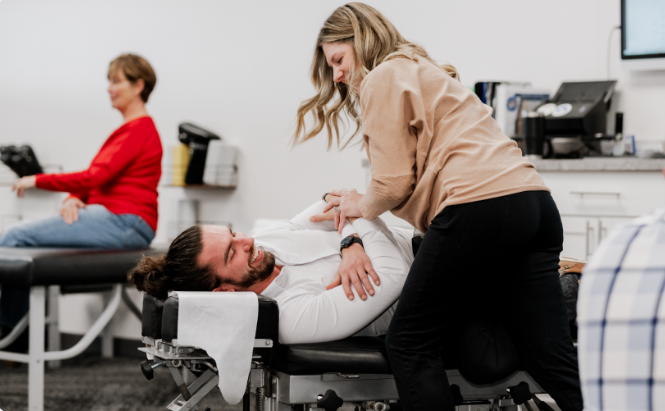
At Ability Chiropractic, you will receive care delivered by trained, licensed professionals with years of education, ongoing hands-on clinical training, and ongoing study of the most effective techniques. When you sit down with one of our doctors, you're in experienced hands that have done this thousands of times, with a provider who takes the time to understand your specific situation before ever touching your spine.
Compared to primary care, chiropractic comes out ahead. Research tracking injury rates found about 40 incidents per 100,000 chiropractic visits, compared to 153 incidents per 100,000 primary care visits. Patients were shown to be at lower risk of injury within a week of a chiropractic visit than after a standard medical visit.
A large Medicare study backs this up directly. Neck pain patients managed with chiropractic care had lower rates of adverse events than those managed through primary medical care. Prescription drug therapy carried the highest risk of the groups studied.
The opioid connection is hard to ignore. Veterans who saw a chiropractor first for low back pain had 90% lower odds of both early and long-term opioid use. Other research found chiropractic patients had 64% lower odds of ever receiving an opioid prescription at all. When you're weighing "safe compared to what," this is the comparison that matters most.
Patients agree. A survey of over 630,000 chiropractic visits found 99% of patients rated their care as good or excellent. That's a real-world satisfaction rate most of healthcare would love to match.
The Real Comparison
No hands-on treatment carries zero risk. Neither does exercise or taking ibuprofen. But that's not the comparison that matters.
The real comparison is this: what happens if you don't act, or if you choose a riskier path?
Surgery carries infection risk, extended recovery, and outcomes that aren't guaranteed. Long-term medication use carries dependency risk, side effects, and — as the opioid data above shows — a well-documented path toward worse outcomes, not better ones. And doing nothing carries its own risk: degeneration that compounds quietly for years until it can't be ignored.
Chiropractic care isn't just the safer option sitting next to those alternatives. It's the smarter one. Millions of visits. Documented outcomes. A track record measured in decades, not anecdotes.
This isn't a coin flip between two risky choices. It's a clear-cut decision, backed by the data.
That's the real question worth asking: not "is there risk," but "what's the safest path to actually getting better?"
The data has a clear answer.
A Path Toward Healing
Medication can quiet pain signals. It doesn't restore the function that caused the pain in the first place. Left unaddressed, the underlying mechanical or nervous system issue often continues — which is part of why so many people find themselves on the same medication, at a higher dose, years later.
Chiropractic care works differently. Instead of interrupting the pain signal, it addresses why the signal is firing — restoring movement and function to the joints and nervous system driving the problem. That's not a replacement for every kind of medical care. It's a different starting point: fix the function, and the symptom often resolves because the cause was actually addressed — not just quieted.
That's the real distinction worth understanding before you decide how to handle pain: are you managing a symptom, or resolving what's causing it? Chiropractic is one of the most studied, most tracked, lowest-risk interventions in musculoskeletal healthcare — and the research has said so consistently for over a decade.
You don't have to take our word for it. Take the data's.
We would love the opportunity to help you on the path to healing, to help you feel better, and to earn your trust with your health.
Let's start that conversation.
Sources
Haldeman S, et al. Malpractice claims review — risk of vertebral artery dissection following cervical manipulation, ~1 in 5.85 million. CMAJ, 2002. https://www.cmaj.ca/content/165/7/907
Chiropractic injury rate vs. primary care injury rate (40 vs. 153 per 100,000 visits). Big Dreamers ABA, Chiropractic Statistics. https://www.bigdreamersaba.com/blog/chiropractic-statistics
Whedon JM, et al. Medicare study — chiropractic care associated with lower adverse event rates than primary medical care for neck pain. Journal of Manipulative and Physiological Therapeutics, 2025. Summarized via ChiroUp: https://chiroup.com/blog/top-chiropractic-research-from-2025-advancing-evidence-based-care-for-chiropractors
Kazis LE, et al. Veterans with low back pain who saw a chiropractor first had 90% lower odds of early and long-term opioid use. BMJ Open, 2020. Corcoran KL, et al. — 64% lower odds of opioid prescription among chiropractic users. Summarized via American Chiropractic Association: https://www.acatoday.org/research/what-research-shows/
Patient satisfaction survey of 630,000+ chiropractic presentations — 99% rated care good or excellent. Big Dreamers ABA, Chiropractic Statistics. https://www.bigdreamersaba.com/blog/chiropractic-statistics