

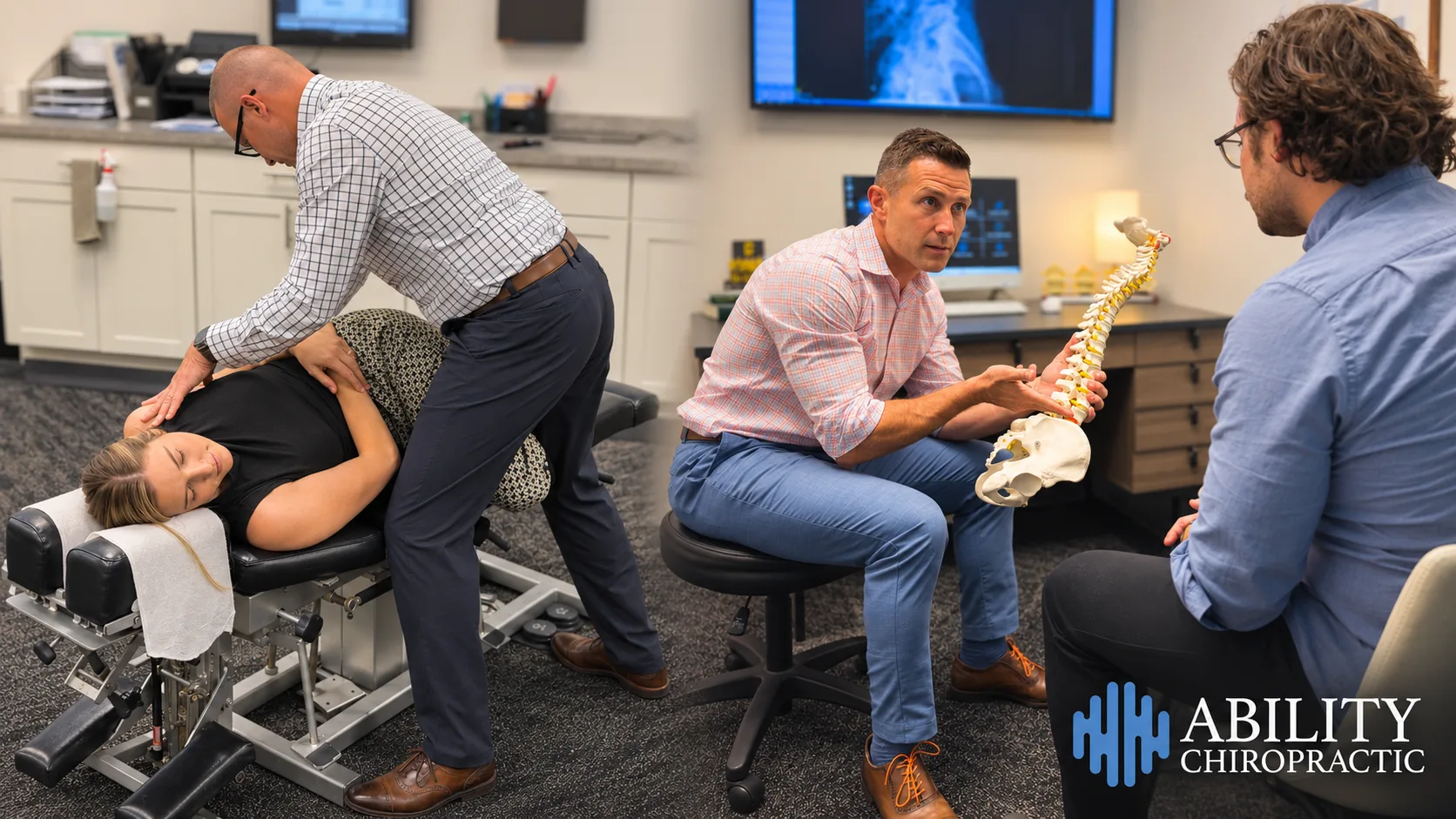
No. Chiropractic care includes treatments backed by clinical trials published in leading medical journals and included in national treatment guidelines. The American College of Physicians recommends spinal manipulation among initial, drug-free options for low back pain. For chronic low back pain, its guideline recommends starting with nondrug treatments before considering medication. [1]
So why does the “pseudoscience” label keep coming up? And if you’re hurting right now, what can chiropractic care actually do for you? Here’s what you deserve to know.
Where did the “pseudoscience” reputation come from?
Organized opposition played a real role. In 1987, a federal judge ruled in Wilk v. AMA that the American Medical Association had participated in an illegal boycott aimed at containing and eliminating the chiropractic profession. The campaign discouraged medical doctors from professionally associating with chiropractors and restricted cooperation in hospitals. The ruling was upheld on appeal in 1990. [4]
That history helps explain some of the longstanding friction between the professions. Today, patients can also look directly at clinical research to understand where chiropractic care can help.
What does the research say chiropractic can help with?
Neck pain. In a National Institutes of Health-funded trial published in Annals of Internal Medicine, researchers followed 272 adults with recent-onset neck pain for a year. Patients assigned to spinal manipulation reported less pain than those assigned to medication at 8, 12, 26, and 52 weeks. Home exercise with advice also performed similarly to manipulation at most time points. [5]
Headaches that start in the neck. In a 256-person trial of cervicogenic headaches, the group receiving 18 spinal manipulation sessions reduced headache days from about 16 to 8 per four weeks. At the main follow-ups, that group had about three fewer headache days than the light-massage control group. [6] Our article Can a Chiropractor Help With Headaches and Migraines? goes deeper into headache types and how neck-related factors can contribute.
Low back pain. A review of 26 randomized trials published in JAMA, the American Medical Association’s journal, found spinal manipulation was associated with modest improvements in pain and function for acute low back pain over up to six weeks. [7] The American College of Physicians includes it among initial nondrug treatment options. [1]
Can chiropractic care help me avoid pain medication or surgery?
Chiropractic care offers a way to address certain back and neck problems without starting with medication or surgery. Research has also found lower rates of surgery and opioid prescriptions among people who received chiropractic care.
In a study following 1,885 workers with occupational back injuries, 42.7% of those who saw a surgeon first underwent lumbar spine surgery within three years, compared with 1.5% of those who saw a chiropractor first. [8]
A separate review of six studies found that chiropractic users had 64% lower odds of receiving an opioid prescription than nonusers. [9] These studies show associations rather than proof that chiropractic care caused the difference; the groups may also differ in their conditions, preferences, and care needs.
For someone looking for a conservative starting point, the practical message is encouraging: there are options worth exploring. An evaluation can help you understand whether chiropractic care fits your situation and goals.
Are chiropractors real doctors?
Yes. Chiropractors earn a Doctor of Chiropractic degree, typically completing four years of professional education after at least three years of undergraduate study. They must meet examination requirements and hold a state license. Training covers anatomy, physiology, diagnosis, and supervised clinical care. Chiropractors are doctors of chiropractic; their training and scope differ from those of medical doctors. [3]
Chiropractic care is also provided within the VA healthcare system. Medicare Part B covers qualifying manual spinal manipulation to correct a spinal subluxation, subject to its coverage requirements. [10,11]
Is chiropractic care safe?
At Ability Chiropractic, we start with your health history and an exam to determine whether an adjustment is right for you. The most common side effects of spinal manipulation are temporary, such as soreness or stiffness, and usually pass within a day. Serious complications are very rare. [2] If we recommend a neck adjustment, we’ll explain why, discuss the risks and alternatives, and answer your questions before you decide how to proceed.
For a closer look at the adjustment itself, read What Happens When a Chiropractor Cracks My Back?.
What happens at Ability Chiropractic?
We start by listening. Your doctor learns your history, your pain, and what you want to get back to. Then we examine how you move, explain what we find, and build a plan with clear goals and check-in points so you can see your progress. If you need a different kind of care, we’ll tell you.
Progress means more than a number on a pain scale. It might mean turning your head more comfortably while driving, working with fewer interruptions, or getting back to exercise and time with your family. Your goals help shape the plan and how we reassess it.
Learn more about our team on our About Us page, or explore Your First Visit to see what to expect.
Form your own opinion through experience
Everyone has an opinion about chiropractic. You deserve the opportunity to ask questions, understand the research, and explore what care could mean for your life.
At Ability Chiropractic, education comes before intervention. Schedule a call with our team and take the first step toward understanding your options.
Prefer to speak with our team? Call 740-410-9355.
References
- [1] Qaseem A et al. Noninvasive Treatments for Acute, Subacute, and Chronic Low Back Pain: A Clinical Practice Guideline From the American College of Physicians. Annals of Internal Medicine. 2017;166(7):514-530. https://doi.org/10.7326/M16-2367
- [2] National Center for Complementary and Integrative Health. Spinal Manipulation: What You Need To Know. https://www.nccih.nih.gov/health/spinal-manipulation-what-you-need-to-know
- [3] U.S. Bureau of Labor Statistics. Chiropractors. Occupational Outlook Handbook. https://www.bls.gov/ooh/healthcare/chiropractors.htm
- [4] Wilk v. American Medical Association, 671 F. Supp. 1465 (N.D. Ill. 1987), affirmed 895 F.2d 352 (7th Cir. 1990). https://law.justia.com/cases/federal/appellate-courts/F2/895/352/46788/
- [5] Bronfort G et al. Spinal manipulation, medication, or home exercise with advice for acute and subacute neck pain: a randomized trial. Annals of Internal Medicine. 2012;156(1 Pt 1):1-10. https://pubmed.ncbi.nlm.nih.gov/22213489/
- [6] Haas M et al. Dose-response and efficacy of spinal manipulation for care of cervicogenic headache: a dual-center randomized controlled trial. The Spine Journal. 2018;18(10):1741-1754. https://pmc.ncbi.nlm.nih.gov/articles/PMC6107442/
- [7] Paige NM et al. Association of Spinal Manipulative Therapy With Clinical Benefit and Harm for Acute Low Back Pain: Systematic Review and Meta-analysis. JAMA. 2017;317(14):1451-1460. https://pubmed.ncbi.nlm.nih.gov/28399251/
- [8] Keeney BJ et al. Early predictors of lumbar spine surgery after occupational back injury: results from a prospective study of workers in Washington State. Spine. 2013;38(11):953-964. https://pmc.ncbi.nlm.nih.gov/articles/PMC4258106/
- [9] Corcoran KL et al. Association Between Chiropractic Use and Opioid Receipt Among Patients with Spinal Pain: A Systematic Review and Meta-analysis. Pain Medicine. 2020;21(2):e139-e145. https://pubmed.ncbi.nlm.nih.gov/31560777/
- [10] U.S. Department of Veterans Affairs. Chiropractic Service. https://www.rehab.va.gov/PROSTHETICS/chiro/index.asp
- [11] Medicare.gov. Chiropractic services. https://www.medicare.gov/coverage/chiropractic-services