
Chiropractic vs. Modern Medicine: Are You Managing Symptoms or Building Health?
One of the biggest misunderstandings about chiropractic is the belief that it is simply an “alternative version” of medicine.
The two professions were built around fundamentally different philosophies, ask different questions, and pursue different outcomes.
When someone develops high blood pressure, chronic pain, acid reflux, headaches, sleep issues, or countless other health concerns, the first question is often, "What can we give them to manage this?" In many cases, the answer is a medication. If that doesn't work, a different medication, if that creates a different symptom, another medication for that, too. If the problem progresses, recommendations can get progressively more aggressive.
Modern medicine is excellent at crisis care, at survival, at temporary symptom supression.
But chiropractic has always been interested in a different question:
Why is this body struggling to begin with?
How well is this person moving? How well is their nervous system communicating and regulating? How well are they adapting to physical, chemical, and emotional stress? How much capacity, resilience, and reserve do they have?
These are health questions, not disease questions.
The distinction becomes clearer when you compare the goals of each approach:
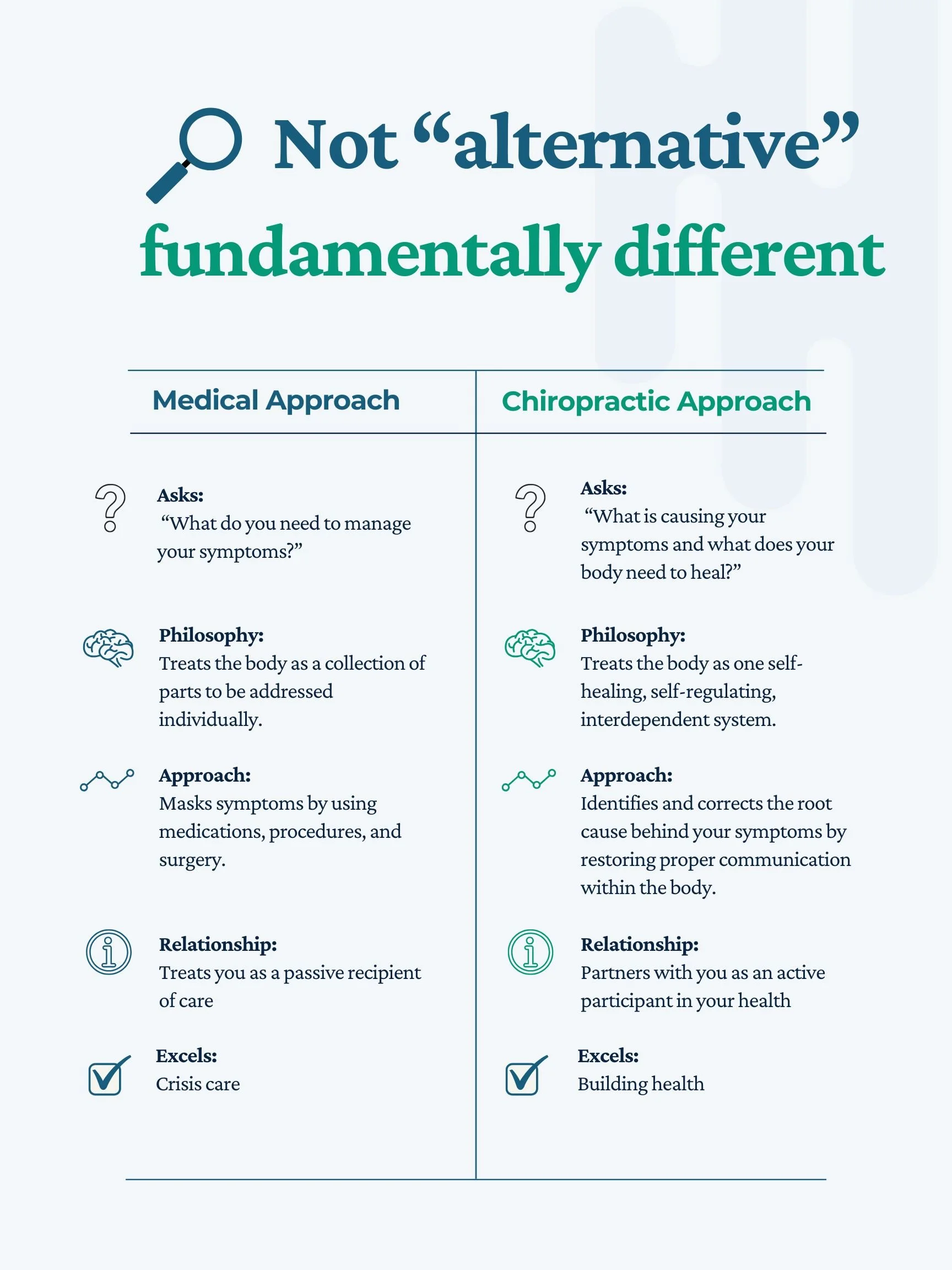
As chiropractors, we are not experts in pharmaceuticals. We are not surgeons. Our expertise is the human body itself.
We have our doctorate in anatomy, neurology, biomechanics, movement, adaptation, and the relationship between the brain and body. We are fascinated by the systems that create health long before disease ever enters the conversation.
That is why chiropractic care is centered around the nervous system and it’s home- the spine. Every experience you have, every movement you make, every adaptation your body performs is coordinated through the communication between your brain and body. When that system functions better, the entire organism has a greater opportunity to function better.
Perhaps the biggest challenge in modern healthcare is that we have become incredibly good at helping people survive after they are already suffering while becoming less skilled at teaching people how to build health and thrive.
We live in a culture that waits for symptoms, searches for diagnoses, and manages conditions. Far fewer conversations are devoted to building resilience, improving function, increasing adaptability, and creating health.
That is the conversation chiropractic has been having from the beginning.
In a world where most conversations revolve around sickness, we believe the conversation about health deserves just as much attention.
If you’re done with managing symptoms and quick fixes that don’t last, we’d love to show you a better way.